Efficient claims management plays an important role in every vehicle fleet, because damage can occur at any time. The costs for company cars quickly increase, processes come to a standstill and additional administrative work arises.
At the same time, fleet tasks are becoming more complex. According to recent industry studies, 83% of fleet managers feel that their work is more demanding today than it was just a few years ago. The handling of claims therefore also requires more structured processes and greater transparency.
But how do fleet managers ensure efficient claims handling under these conditions? And which steps are crucial today? This is exactly what we show you in this article.
Contents
What does fleet claims management mean?
Effective claims management is an important area of fleet management. It encompasses all processes and strategies that are used to handle damage to a company’s or organization’s vehicles. If an accident or vehicle damage occurs in the fleet, a quick response is required. Failure to do so may result in significant disruptions to mobility and operations. This can lead to delays in order processing, restrictions on operational capacity and additional costs for replacement vehicles or repairs.
Efficient claims management helps to keep costs as low as possible and minimize downtimes. Damage prevention is also an important aspect of this in order to reduce the risk of accidents and vehicle defects in advance. This includes processes such as regular maintenance, comprehensive driver training, driving license checks and driver safety training. When purchasing new company vehicles, you should also make sure that the vehicles are up to date in all technical and safety-related aspects.

Digital support for loss prevention with Fleet+
Keep an eye on all inspection dates with Fleet+ fleet management software and support fleet safety digitally.
Fleet tasks are becoming more complex - what this means for claims management
According to the latest Dataforce Fleet Management Study 2024, 83% of fleet managers state that their tasks have become more complex in recent years. New legal requirements, rising costs, increasing documentation obligations and the pressure to digitalize mean that operational processes have become significantly more demanding.
This development is particularly evident in claims management. While the focus used to be on pure claims processing, fleet managers now have to focus on additional tasks:
- Protect against liability risks
- Fully document evidence
- Efficient control of insurance processes
- Coordinate internal communication
- Transparent evaluation of cost trends
Damage is therefore no longer just an individual event, but part of a complex process structure in the fleet.
Claims management process: The most important tasks for fleet managers
If, despite all precautionary measures, an accident or damage occurs in the fleet, quick and structured action is required. Effective claims management as part of fleet management helps to minimize downtimes and control costs. The following steps should be observed:
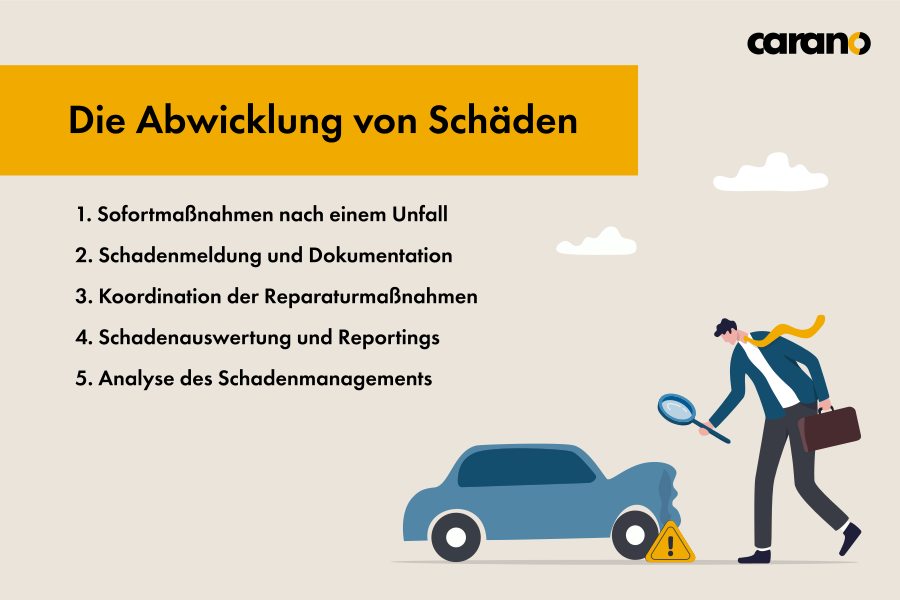
Step 1 - Immediate measures after an accident
After an accident or vehicle damage, the safety of everyone involved is paramount. The scene of the accident must be secured to prevent secondary accidents. If necessary, the police and emergency services should be notified immediately. The incident must then be documented in detail with a damage report: An accident report with all relevant details is essential for reporting. This includes photos of the damage, a record of the accident site and the contact details of all parties involved and possible witnesses.
Step 2 - Reporting a claim to the insurance company
As soon as the immediate measures have been completed, the damage must be officially reported. This is done both internally and with the insurance company. Complete documentation is crucial in claims processing to ensure that the process runs smoothly. In addition to the accident report, all relevant documents such as photos, witness statements or expert reports should be included. A thorough review of the damage also helps to realistically assess the need for repairs and find cost-efficient solutions.
Step 3 - Organizing the repair
In order to minimize vehicle downtime and ensure mobility, the fleet manager needs to carry out repairs quickly and efficiently. A suitable workshop or partner company must be commissioned for this purpose. If the damaged vehicle is essential for the business, a replacement vehicle should also be organized. Pool vehicles can also be used for this purpose to ensure that all employees remain mobile. During the repair phase, it is important to monitor progress regularly and ensure that the work is carried out quickly.
Step 4 - Damage evaluation and reporting
Effective vehicle claims management requires close coordination with the insurance company in order to expedite claims settlement as quickly as possible. In addition, relevant internal departments must be informed about the incident, especially if the damage has an impact on operational processes. Transparent communication with the affected drivers and, if applicable, customers also helps to avoid uncertainty and maintain trust.
Step 5 - Analysis and optimization of claims management
After the claim has been settled, the incident should be thoroughly analyzed. Important questions are: What was the cause of the damage? Was it human error or external influences? Based on these findings, preventative measures can be taken, such as driver training or the use of technical assistance systems. It is also worth regularly reviewing cost trends and identifying optimization potential in claims management. In this way, vehicle defects can be averted as far as possible in the future. Fleet management software can support you in analyzing your fleet.
Increasing complexity requires structured processes
The study also shows that fleet managers have less and less time for strategic tasks because operational activities dominate. Claims are one of the biggest time factors in day-to-day operations.
Manual processes, Excel lists and scattered documents add to the administrative burden. Every missing piece of information, every unclear area of responsibility and every undocumented approval increases the risk of delays and unnecessary costs.
Structured, digitally supported claims management processes are therefore becoming a necessity rather than a convenience. Those who record damage reports centrally, document repair processes in a traceable manner and create automated evaluations measurably reduce complexity.

From an operational burden to a controllable process landscape
The Dataforce Study 2024 clearly shows that fleet managers are increasingly tied up in operations. Strategic issues such as cost control, sustainability or risk minimization are taking a back seat because claims and administrative tasks take up time.
This is precisely where the structural problem lies in the claims management of many fleets: there is not a lack of expertise, but rather a lack of systematic process support.
If damage reports are received decentrally, repair approvals are sent by e-mail and documents are stored in a distributed manner, there is a permanent coordination effort. Transparency is only created through active follow-up, not through system logic.
A digital claims file, such as the one Carano provides in Fleet+, shifts this focus.
The focus is not on coordination, but on structured control:
- All claims information is available centrally
- Status changes are documented in a traceable manner
- Responsibilities are clearly assigned
- Focal points of damage can be systematically analyzed
This transforms claims management from a reactive effort into a controllable component of overall fleet management.

Claims management with Fleet+
Our Fleet+ fleet software digitalizes and simplifies claims management: collect all images, expert reports and invoices in a digital claims file and analyse the main points of damage. Drivers can report damage directly via the web application.
Claims management starts with prevention
Efficient claims management starts with preventing accidents and damage in the fleet. This includes regular UVV driver training. Drivers are trained in the safe handling of company vehicles and how to behave correctly in the event of an accident. It is extremely important to document all training courses carried out, as there may be severe penalties in the event of a claim if the training was not carried out or not documented.
The operational safety of the vehicles should also be ensured as part of claims management. Regular maintenance and servicing measures, as well as the UVV vehicle inspection, help to prevent damage and ensure road safety. Digital claims management with software makes it possible to keep an eye on important dates automatically.
In addition, driving license checks are an important measure to improve the safety of all road users and prevent accidents.
Digital claims management: software supports fleet managers
Digitalization helps fleet managers to make communication processes more efficient and thus save time and costs in the long term.Digital solutions can help speed up processing times and keep costs as low as possible, particularly in the area ofclaims management. In addition, fleet software offers the option of collecting all relevant documents relating to the damage, such as images, repair approvals or expert reports, centrally in a digital damage file.
Comprehensive reporting is time-consuming and a decisive cost factor, especially in the management of large fleets. Software solutions that automatically keep an eye on vehicle costs, evaluate damage or remind you of safety-relevant deadlines such as UVV driver training or driving license checks offer a great deal of savings potential in the long term.
Fleet management software supports you with the following functions:
- Damage file including pictures, expert reports and other documents
- Analysis of key damage areas
- Automated communication with the insurance company
- Monitoring of claims settlement
- Decentralized online claims reporting by drivers

Safe on the road: driver training according to UVV
Carano’s e-learning course trains drivers in the safe handling of company vehicles. All results are fully documented and serve as proof in the event of a claim.
What are the advantages of outsourcing claims management?
In many fleets, service providers take care of claims handling, saving fleet managers a lot of time. But here, too, it is important to carefully consider outsourcing, as there is a wide range of choices on the market. This checklist can help with the selection of an external service provider:
- Service times and service hotlines
- Help with damage abroad
- Service packages, e.g. communication with the workshop, fast procurement of a replacement vehicle
- Reporting options
- How much time does the fleet manager still have to invest?
Whether a leasing provider, a fleet company or a car insurance company takes over claims handling is ultimately always a matter of judgment. It is important to check internal capacities carefully before outsourcing claims management.
Small fleets in particular, where not every position can be filled by a specialist, benefit from outsourcing and can devote more time to other fleet-related issues thanks to the reduction in workload. Particularly when it comes to legal expertise, fleet managers should not shy away from calling in an expert service provider to handle claims in order to be able to estimate and minimize potential legal costs at an early stage.
Conclusion
- Effective fleet claims management is crucial to minimizing downtime, reducing costs and maintaining smooth operations.
- Preventive measures such as regular maintenance, training and the use of modern technologies can significantly reduce the risk of damage.
- Digitalization and software support offer fleet managers a valuable opportunity to reduce their administrative workload and focus on strategic tasks.
FAQ - Claims management
Damage management in the fleet includes all organizational and operational measures for recording, processing and avoiding defects in company vehicles. This includes the structured recording of damage, the efficient coordination of repairs, processing with insurance companies and the optimization of internal processes. The aim is to minimize downtimes, reduce costs and ensure operational mobility.
Efficient claims management comprises several coordinated steps: immediate measures at the scene of the accident, structured claims reporting, complete documentation, coordination of the repair and subsequent analysis of the incident.
It is important to have a clear process structure so that downtimes are minimized, costs are controlled and all processes are documented in a traceable manner.
Costs can be reduced primarily through fast response times, transparent processes and preventative measures.
The more structured damage is recorded and evaluated, the better recurring causes can be identified and avoided in a targeted manner. Digital solutions such as Fleet+ from Carano help to document damage reports centrally, map processes in a traceable manner and systematically evaluate cost trends.
This lowers repair costs, reduces downtime and improves the cost-effectiveness of the fleet in the long term.
Fleet management software, such as Carano, digitizes and centralizes all claims-related processes.
Damage reports, photos, expert reports and repair approvals are stored in a digital damage file. Automated reminders, transparent status overviews and systematic evaluations make management easier and reduce administrative work.
This transforms claims management from a reactive administrative process into a structured, controlled component of fleet management.
Professional claims management contributes significantly to the economic and operational efficiency of a company. Inadequately regulated processes lead to longer downtimes, increased administrative work and rising costs. Clear processes and fast processing can reduce financial burdens, effectively manage insurance claims and establish preventive measures to avoid damage in the long term.
Rapid damage assessment, the selection of cost-effective repair partners and preventive measures such as driver training or assistance systems help to reduce costs. The use of software can optimize claims management processes and thus save costs.
Further articles on claims management and vehicle fleets
Fleet management tasks: The 10 most important fleet activities
10 tips for efficient and successful fleet management
Fleet analysis: Analyzing the fleet step by step
Car Policy: Significance and advantages of a company car policy in the vehicle fleet
The fleet manager as a key role in the company
Fuel cards for companies: Efficient management of fuel costs in the fleet
Sustainable vehicle fleet: measures for more environmental and climate protection in the fleet
Corporate car sharing: advantages for companies, fleets and drivers