
Fleet management as a service: Why traditional structures are no longer enough at ISS? What happens when fleet management doesn’t just work internally, but becomes part of a service offering?
ISS Energy Services GmbH faced precisely this challenge. As a facility management service provider, ISS not only manages its own vehicle fleet, but is increasingly taking on responsibility for the management and control of vehicles in the customer environment.
With 450 vehicles, over 8,500 employees and 125 locations, a structure was created early on in which traditional approaches to fleet management were no longer sufficient. Today, the fleet comprises more than 4,000 vehicles – with increasing complexity in all areas of fleet management.
The central question was therefore no longer how to manage a fleet, but how to bundle processes, data and responsibilities in a scalable system logic.
Contents
When fleet processes no longer function linearly
The biggest challenge lay in the structure itself. Different vehicle types, decentralized locations and diverse requirements meant that existing processes could no longer be controlled efficiently.
Data on vehicle management, drivers and ongoing measures was distributed across various systems. A consistent overview of the entire fleet was only possible with considerable effort.
Everyday life has shown that traditional administration is reaching its limits:
- Information had to be maintained several times
- Evaluations were delayed
- Coordination between locations cost time
- Operational processes were difficult to standardize
For fleet management, this meant: increasing effort with simultaneously decreasing controllability.

Minimize your fleet costs with the fleet management software Fleet+
Fleet+ from Carano: from management tool to central control platform
With Fleet+ from Carano, a fleet management software was deliberately introduced that not only digitizes individual tasks, but also functions as a central software solution.
The decisive difference: Fleet+ not only maps the administration, but also restructures the entire fleet management.
All relevant areas are brought together in one platform:
- Vehicles and their use
- Drivers and responsibilities
- Operational and strategic processes
- Documentation and control
- Reporting and analyses
This creates a system architecture in which even complex structures can be controlled efficiently.
Digital database instead of fragmented systems
A key step was the complete digitization of all relevant information. The previously grown, partly manual structure was replaced by a central, intuitive platform.
Vehicle management is now completely digital. All data on vehicles, drivers and the entire fleet can be accessed and linked at any time.
This fundamentally changes the daily work in fleet management. Decisions are no longer based on individual data sources, but on a consistent, fully integrated information base.
For the fleet manager, this creates a new form of control that requires significantly less operational effort.
Automated processes as the key to efficiency
A key advantage of the software solution is the ability to automatically map recurring tasks. Many processes that were previously organized manually now run in the background.
These include scheduling, reminders, documentation and recurring checks. This automation ensures that the effort involved in fleet management can be noticeably reduced.
At the same time, clearly defined, standardized processes are created that function independently of location or vehicle type.
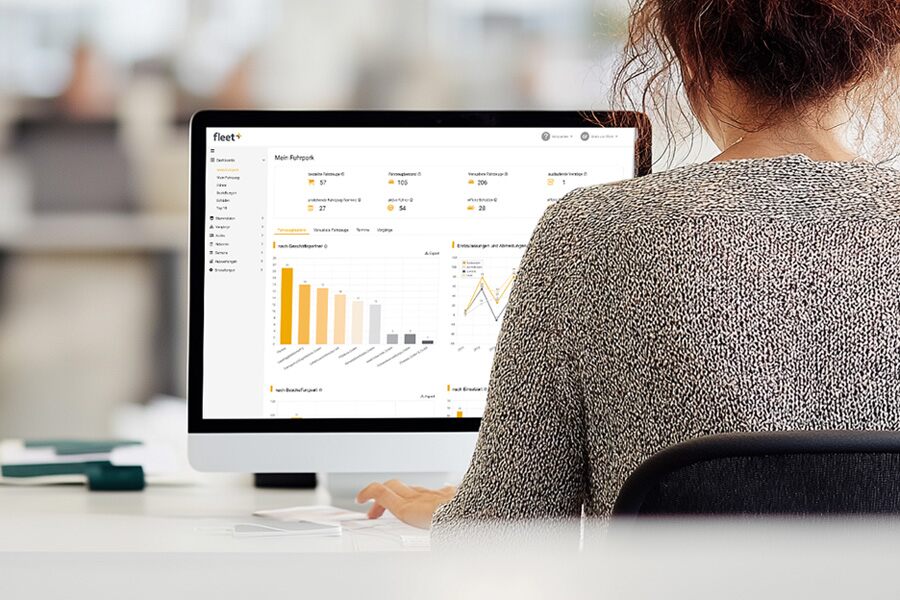
Analysis and evaluations as a basis for decisions
With Fleet+, the use of data becomes an active part of fleet management. Instead of isolated information, detailed evaluations are now available that enable in-depth analysis.
This concerns, among other things:
- Use of individual vehicles
- Development within the fleet
- Efficiency of processes
- Economic key figures
This transparency makes it possible not only to react to developments, but also to actively control fleet management.
Legal certainty and electronic control in the vehicle fleet
In addition to efficiency, compliance with legal requirements also plays a key role. Fleet+ supports ISS in electronically mapping relevant checks and controls and documenting them in the system.
All measures are automatically recorded and stored in a traceable manner. This creates a reliable basis for legally compliant processes throughout the entire fleet.
For fleet managers, this means more security and less effort in operational implementation.
Electromobility as an additional complexity factor
As the proportion of electric vehicles increases, so does the complexity of fleet management. Different requirements for range, energy consumption and billing must be integrated into existing structures.
Fleet+ offers a flexible basis for managing both classic and e-vehicles in a shared platform. This means that management remains efficient and scalable even with increasing diversity.
Discover how Carano can also ensure clear structures and secure documentation in your company.
Conclusion: fleet management software as a platform for complex structures
- The development at ISS clearly shows that modern requirements in fleet management can no longer be solved with isolated tools.
- With Fleet+ from Carano, a central platform has been created that integrates all vehicles and the entire fleet, standardizes and automatically controls processes, simplifies administration and makes it more efficient, enables analysis and evaluations and ensures legally compliant controls.
- Particularly in complex company structures, it becomes clear that fleet software is not just a tool, but the foundation for scalable and future-proof fleet management.
Frequently asked questions
Fleet management software creates a central overview of all vehicles, costs and deadlines in the fleet. Companies benefit from structured processes, automated workflows and significantly more efficient fleet management.
Yes, even smaller companies benefit from fleet software. Especially as the fleet grows, it helps to establish structures at an early stage that provide a clear overview and reduce future expenses.
Fleet software supports fleet management by bundling all relevant data centrally and enabling comprehensive control. Solutions such as Fleet+ from Carano help to digitize processes, create a clear overview of the entire fleet and organize fleet management efficiently.
The main advantages lie in the improved overview, more efficient processes and structured fleet management. With fleet software such as Fleet+ from Carano, fleet processes can be automated, costs can be displayed more transparently and well-founded decisions can be made.
Fleet management software is a digital solution for the centralized management of a vehicle fleet. It helps to organize vehicles, drivers, costs and appointments and provides a comprehensive overview of all relevant data.
As a rule, responsibility lies with the fleet manager. They are responsible for organizing the fleet, controlling processes and ensuring a clear overview with the help of fleet software.
When purchasing fleet management software for – particularly large and heterogeneous – fleets, it is crucial that the solution is functionally suited to the individual processes, is scalable and can be seamlessly integrated into existing systems – requirements that are specifically covered by solutions such as Fleet+ from Carano.
In order to digitalize fleet management, all existing processes should first be analysed and then transferred to suitable fleet software such as Fleet+. The aim is to create a central fleet management system that provides a complete overview of vehicles, drivers and processes.
Further contributions
Claims management: How to handle damage to your fleet professionally
Fleet safety: How to minimize the risk of accidents
Safety and transparency in the vehicle fleet: why a company car policy is essential
Fleet Management: Basics, Legal Requirements and Tasks
Fleet insurance: cover for your vehicle fleet
The 5 advantages of fleet management software for your company
Fleet management tasks: The 10 most important fleet activities
10 Tips for Successful and Efficient Fleet Management
Mobility Budget Instead of Company Car: Flexible Mobility for Employees
Bicycles in the company: A sustainable alternative for employee mobility
E-mobility in the Company: 5 Important Points of the Fleet Analysis
Driver instruction according to UVV: Download template as PDF
Fuel cards for companies: Efficient management of fuel costs in the fleet
Bicycles in the company: A sustainable alternative for employee mobility
Fleet Management: Modern vehicle management for maximum fleet efficiency
Car Policy: Significance and advantages of a company car policy in the vehicle fleet
Fleet optimization – efficiency and digitalization in modern fleet management
Vehicle management: efficient processes for a modern vehicle fleet
Excel fleet management: a practical start or an outdated concept?
Fleet management: How to manage your fleet successfully
Claims management software: How fleets benefit from digitalization
Sustainable mobility starts with the vehicle fleet: electrification & environmental measures
Owner liability in the fleet: These obligations apply to fleet managers
Fleet management system: Efficient management of modern vehicle fleets
Sustainable fleet management: strategies, processes and control for sustainable companies
Employer Driving License Check: Legal Regulations and Tips for Implementation
450 vehicles in the fleet: How POCO manages its fleet costs transparently with Fleet+