In times of rising operating costs, increasing environmental regulations and growing complexity in vehicle management, many companies are faced with the question: How can their own vehicle fleet be designed to be truly efficient, digital and future-proof? Targeted fleet optimization makes it possible to simplify processes, create transparency and make better use of resources: from vehicle procurement to daily use.
But the demands on modern mobility are changing rapidly. New technologies, digital tools and sustainable strategies open up opportunities, but also present fleet managers with new challenges.
Read this article to find out how you can take advantage of these developments and optimize your fleet step by step.
Contents
Why fleet optimization is crucial for companies
An efficient fleet is far more than just a collection of vehicles – it is a central component of the company’s processes. In many companies, fleet management generates considerable costs and ties up valuable resources. Without structured planning and modern tools, there is a risk of inefficiencies, unused potential and rising operating expenses. This is precisely where targeted fleet optimization comes in.
By continuously analyzing and improving processes, savings can be made, profitability increased and ecological goals supported at the same time. Especially in the context of professional fleet management, it becomes clear how closely efficiency, sustainability and transparency are linked.
Companies that manage their fleet strategically and make data-based decisions benefit from clear advantages: lower fuel consumption, less maintenance, optimized vehicle usage and smooth driver deployment. This not only makes the fleet more cost-efficient, but is also an important factor for long-term competitiveness.
Investing in the digital and efficient design of your mobility today creates the basis for a sustainable and future-proof fleet strategy.
The biggest challenges in fleet management
The requirements for modern fleet management are constantly growing. Companies need to coordinate their vehicles, drivers and processes efficiently, while at the same time meeting legal requirements and ensuring the cost-effectiveness of the entire fleet. Many fleet managers are faced with the challenge of maintaining an overview of complex structures, data and processes.
A key problem is the lack of transparency. Without central systems or digital processes, information is often recorded manually – for example on maintenance appointments, driver’s license checks or fuel consumption. This fragmented database makes it difficult to make targeted decisions and often leads to higher fleet costs.
In addition, there are rising expectations in terms of sustainability and efficiency. Companies are expected to reduce
Those who do not actively address these factors risk unnecessary costs, inefficiencies and compliance risks. Modern, digital fleet management provides a remedy here: it enables automated processes, up-to-date data insights and effective control of the entire vehicle fleet, the key to long-term optimization and future-proofing.

Minimize your fleet costs with our fleet software Fleet+
Digital solutions for efficient fleet management
Digitalization is changing the fleet management fundamentally. More and more companies are realizing that manual processes in fleet management are no longer sufficient to keep pace with increasing requirements, costs and legal regulations. Modern fleet management software can help here by automating processes, centralizing data and providing a sound basis for decision-making.
Digital systems make it possible to automatically monitor maintenance intervals, driver’s license checks, contracts and fuel consumption. This reduces administrative effort while increasing transparency and efficiency. Integrated analyses can also be used to identify trends – for example, where the vehicle fleet can be optimized or which measures can contribute to sustainability .
A decisive success factor is the linking of all relevant information in a central platform. In this way fleet managers an overview of their vehicles, costs and driver activities at all times. Digital solutions such as Fleet+ from Carano support this approach by efficiently mapping the entire fleet optimization process, from administration to strategic control.
The benefits are obvious: less administrative work, better data bases and a clear path to greater efficiency and sustainability in fleet management.
Fleet management software: functions and advantages
Modern fleet management software forms the backbone of an efficient fleet organization.
The focus is on a digital vehicle file that bundles all information on vehicles, contracts and costs. This allows fleet managers to keep track of maintenance, lease terms and claims at all times. Recurring tasks such as driving license checks, deadline monitoring or recording fuel consumption run automatically in the background – reliably and audit-proof.
The most important advantages at a glance:
-
Automated processes: Less manual work thanks to digital workflows and reminder functions.
-
Transparent database: All relevant vehicle data available centrally – for well-founded decisions.
-
Integrated evaluations: Reports on costs, consumption, CO₂ emissions and efficiency in real time.
-
Flexible interfaces: Seamless connection to systems such as accounting, fuel card providers or HR software.
Sustainability and efficiency in the vehicle fleet
Sustainability and economic efficiency are among the most important goals of modern fleet strategies today. Companies are faced with the challenge of combining ecological responsibility with economic thinking, a task that is particularly important in fleet management. fleet management becomes noticeable.
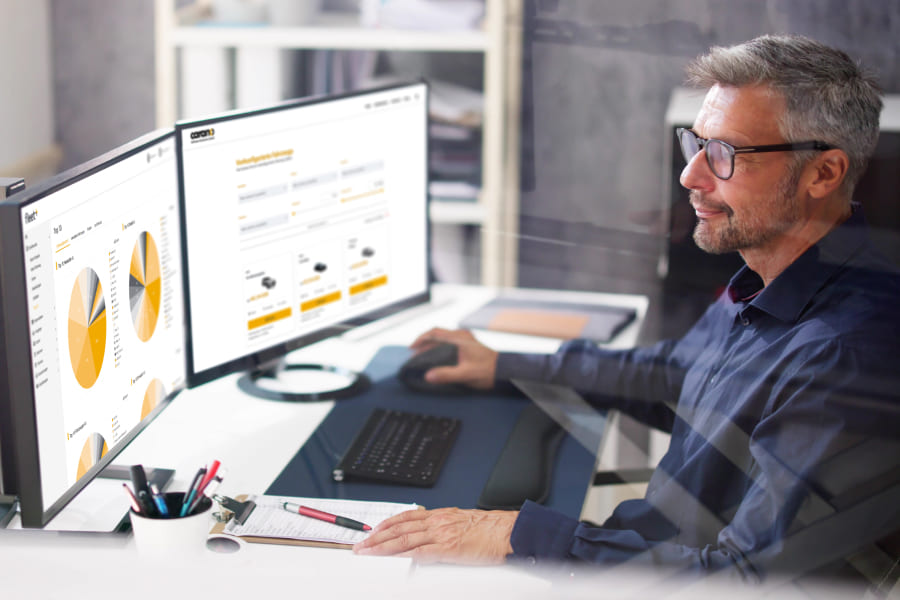
A decisive lever lies in the consistent digitalization of processes. Managing your fleet with modern fleet software creates transparency regarding costs, consumption and usage. Automatic evaluations show where there is potential for savings, be it through optimized routes, lower fuel consumption or the targeted use of electric vehicles. This makes profitability measurable and sustainability plannable.
The integration of new forms of mobility is also playing an increasingly important role. Many fleet managers are increasingly focusing on e-mobility, combining company vehicles with car sharing models or enable employees to use company cars flexibly. This diversity not only increases efficiency, but also supports sustainable corporate goals.
A good software solution helps to store all relevant documents and evidence, from CO₂ reports to maintenance logs, centrally and manage them in an audit-proof manner. At the same time, processes such as driver training can be mapped digitally, reducing administrative tasks and reliably fulfilling legal requirements.
Anyone who aligns their fleet in this way combines ecological responsibility with economic strength – and creates the basis for future-proof, sustainable mobility.
Digitize your fleet with software solutions from Carano
Conclusion: How to achieve comprehensive and efficient fleet optimization
- Successful fleet optimization is an ongoing process that uses transparency, clear structures and digital software for efficient management and data-based decisions.
- Digitalization makes fleets efficient and sustainable, automates processes and provides fleet managers with an overview for the targeted use of resources
- Successful fleet optimization requires strategic thinking and digital use in order to make the fleet economical, transparent and sustainable.
FAQ on fleet optimization
Modern fleet management software can map almost all vehicle types – from cars, vans and commercial vehicles to e-vehicles and pool vehicles. Company cars, leased vehicles or car-sharing vehicles can also be managed centrally. By digitally recording all relevant data, companies can keep track of their entire fleet at all times.
The aim of fleet optimization is to reduce costs, simplify processes and increase efficiency. Companies want to reduce fuel consumption, plan maintenance expenses better and optimize vehicle usage. At the same time, sustainability is playing an increasingly important role – for example by switching to e-mobility or data-based control of all journeys.
Fleet optimization refers to all measures that contribute to making the fleet more economical, transparent and sustainable. This includes the analysis of costs and usage, the automation of administrative processes and the use of modern fleet software. The ability to digitize processes means that decisions can be made based on data and the entire administration can be made more efficient.
Intuitive operation, flexible interfaces and a high degree of automation are important. A good software solution should cover all relevant areas – from vehicle management to reporting. Issues such as data protection, scalability and regular updates are also crucial in order to work efficiently in the long term.
A vehicle fleet can be optimized by consistently mapping processes digitally and regularly evaluating key figures. Digital tools help to plan maintenance automatically, analyze fuel and leasing costs or manage the use of
Further contributions
Claims management: How to handle damage to your fleet professionally
Fleet safety: How to minimize the risk of accidents
Safety and transparency in the vehicle fleet: why a company car policy is essential
Fleet Management: Basics, Legal Requirements and Tasks
Fleet insurance: cover for your vehicle fleet
The 5 advantages of fleet management software for your company
Fleet management tasks: The 10 most important fleet activities
10 Tips for Successful and Efficient Fleet Management
Mobility Budget Instead of Company Car: Flexible Mobility for Employees
Bicycles in the company: A sustainable alternative for employee mobility
E-mobility in the Company: 5 Important Points of the Fleet Analysis
Driver instruction according to UVV: Download template as PDF
Fuel cards for companies: Efficient management of fuel costs in the fleet
Bicycles in the company: A sustainable alternative for employee mobility
Fleet Management: Modern vehicle management for maximum fleet efficiency
Car Policy: Significance and advantages of a company car policy in the vehicle fleet
Claims management software: How fleets benefit from digitalization